
A belated Happy New Year to you all! I’m excited to announce that the new short-form video series I created with my son Russell for the Cornell Lab of Ornithology is now live!
We decided to get creative with our wildlife cinematography tools like a super-slow-motion camera, super telephoto lenses and a unique probe lens to reveal aspects of the lives of our common backyard birds in ways you likely haven’t seen before. The Cornell Lab liked the idea, so whenever we weren’t on other assignments last winter, Russell and I spent our time filming right in our own backyard in Massachusetts.
We both learned so many new things about our common birds by just spending many hours watching them and trying to film their behavior. It was a reminder that you don’t have to travel to the other side of the world to experience the wonder of nature. Just step outside and practice being a good observer!
The first episode officially dropped on Sunday Jan 11 on the Cornell Lab Youtube Channel, and you can watch it here:

Tufted Titmice at Sunrise

With my Backyard Birds Revealed project, getting creative with filming and photographing birds right in my yard (and even right at my bird feeder like in this shot) was a fun challenge. On this day I lined up my bird feeder directly in front of the rising sun and captured this artsy silhouette of squabbling titmice. One of the things that makes wildlife photography endlessly fascinating is that it is an art form where you combine your creative ideas with an element of chance or luck. You don’t control your subjects or their movements, and can’t anticipate their behavior or wing positions precisely, so you never know exactly what you might get. The combination of your ideas on how to create the image plus the serendipity of the natural world creates the art. This shot is a perfect example of that.
Five Episodes of Backyard Birds Revealed
Here is an image representing each of our five episodes of Backyard Birds Revealed:

Episode 1: We reveal how birds make controlled landings at your feeder – in epic super-slow-motion.

Episode 2: The beauty of birds in the snow – and how birds stay warm in the winter.

Episode 3: Skirmishes at the bird feeder – what’s the pecking order at your bird feeder?

Episode 4: Curious about tree cavities – why are so many birds interested in woodpecker holes?

Episode 5: Tree trunk birds – how woodpeckers and nuthatches navigate the vertical world.
You can watch them all on the Cornell Lab of Ornithology’s YouTube channel.
BEHIND THE SCENES – BACKYARD BIRDS REVEALED:
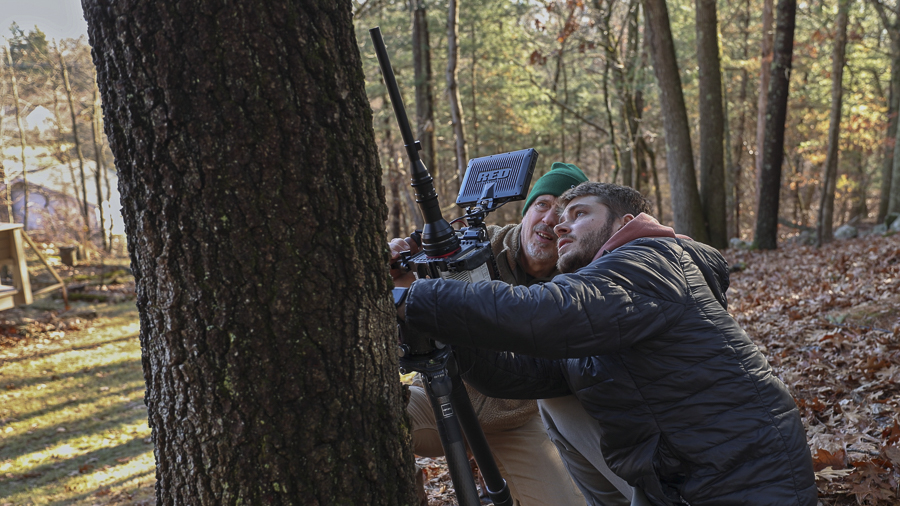
We deploy our camera with a probe lens to get footage with the POV of a tree-trunk climbing bird.

One of the cameras we used was a super-slow-motion camera that filmed at 1000 frames per second, slowing down real time by 40x. Here we review a shot on the camera back.
Special thanks to Kron Technologies for the use of their Chronos 4K12 camera.
Thanks for tuning in, and I hope that Backyard Birds Revealed inspires you to go outside this year and enjoy nature wherever you live. If you are into lifelong learning and supporting good causes, here see below for a few ideas for you to consider for 2026.
Warmest regards,
Tim Laman
A FEW IDEAS FOR 2026
- Sign up for the “Save Wild Orangutans” Newsletter.
Every month, the team from the Gunung Palung Orangutan Conservation Program (full disclosure – led by my wife, orangutan researcher Cheryl Knott) puts out their “Code Red” newsletter reporting on their activities, discoveries, and events in and around Gunung Palung National Park in West Kalimantan, Indonesia. It’s a wonderful window into the lives of wild orangutans and the people working to protect their habitat and ensure that the communities around Gunung Palung are also thriving. The newsletter if free, but I hope you will be inspired to become a monthly contributor. It feels good to be making a small contribution to orangutan conservation each month, even if it’s just the price of one fancy coffee.
https://www.savewildorangutans.org
2. Sign up for the “Lukas Guides” Newsletter.
Every week, David Lukas, a gifted naturalist, thinker, and extraordinarily talented observer of nature publishes a newsletter with his unique insights and research into a topic that takes his fancy. I look forward to these brief reads, where I always learn something that I find myself thinking about later when I’m out in the field. Again, David’s newsletter is free, but if you find it as worthwhile to read as I do, he offers an option to be a paid subscriber and support his work. Do check it out.
3. Commit to Improving Your Wildlife Photography.
Are you interested in photographing birds or wildlife in general? In the photo workshops that I sometimes teach for Lindblad/NatGeo Expeditions, I find that many photographers are obsessing about camera settings and not focusing on thinking creatively in the field about the elements that make a strong wildlife image. I therefore created my own Bird Photography Masterclass called “Getting Creative”. It could be just the thing to help you take your photography to a whole new level this year. If you are more of a beginner, there is also a course to get you started in bird photography called “Birds, Camera, Action”.